Total Hip Replacement (Arthroplasty)
Replacing a damaged hip joint to relieve pain and restore movement
Total Hip Replacement (Arthroplasty)
Replacing a damaged hip joint to relieve pain and restore movement
Total hip replacement, also known as hip arthroplasty, is a surgical procedure used to treat severe hip pain and stiffness caused by arthritis, injury, or other conditions affecting the hip joint. When the joint becomes significantly damaged, everyday activities such as walking, climbing stairs, or getting in and out of a chair can become increasingly difficult.
The hip is a ball-and-socket joint, where the rounded head of the thigh bone (femur) sits within the socket of the pelvis. The joint surfaces are normally covered with smooth cartilage that allows the hip to move freely and absorb load during movement. Over time, this cartilage can wear away or become damaged, leading to pain, inflammation, stiffness, and reduced mobility.
During total hip replacement surgery, the damaged joint surfaces are carefully removed and replaced with prosthetic components designed to recreate the natural movement of the hip joint. Dr Harvie performs total hip replacement surgery for patients experiencing persistent hip pain that has not improved with non-surgical treatments such as physiotherapy, medications, or injections. The aim of surgery is to relieve pain, improve joint movement, and help patients return to daily activities with greater comfort.
The information on this page is designed to help you understand the key aspects of hip replacement surgery, including the symptoms that may indicate joint damage, how the procedure works, the surgical techniques used by Dr Harvie, and what to expect during recovery.

Symptoms of hip arthritis and joint damage
Are you a suitable candidate for total hip replacement?
Is bilateral hip replacement an option for you?
Anterior vs posterior hip replacement surgical approaches
Patient-specific planning and technology used in hip replacement
Hip replacement implants and prosthetic components
Advantages of total hip replacement surgery
What are the potential risks of hip replacement surgery?
Your total hip replacement with Dr Paul Harvie
How pain is managed after hip replacement surgery
Recovering from total hip replacement surgery
Physiotherapy and rehabilitation guidelines after hip replacement
How long does a hip replacement last?
Frequently Asked Questions About Total Hip Replacement Surgery
Symptoms of Hip Arthritis and Joint Damage
Hip arthritis and other conditions affecting the hip joint often develop gradually over time. As the cartilage within the joint wears down or becomes damaged, movement of the hip can become painful and restricted. Many patients initially notice discomfort during activity, which may slowly progress to more persistent pain and stiffness that affects everyday tasks.
Common symptoms of hip arthritis and joint damage include:
• Hip pain during walking or standing: Pain may be felt deep in the groin, the front of the hip, or sometimes the buttock. It may worsen with walking, standing for long periods, or physical activity.
• Stiffness in the hip joint: The hip may feel stiff, particularly after periods of rest such as first thing in the morning or after sitting.
• Reduced range of movement: You may find it difficult to bend, rotate, or move your hip normally. Activities such as putting on shoes and socks or getting into a car may become challenging.
• Pain that radiates to the thigh or knee: Hip joint pain can sometimes be felt further down the leg, particularly in the thigh or knee.
• Difficulty with everyday activities: Tasks such as climbing stairs, walking longer distances, or standing up from a seated position may become increasingly difficult.
• Persistent pain that interferes with sleep: As arthritis progresses, hip pain may occur even when resting and may disturb sleep.
If these symptoms continue despite non-surgical treatments such as physiotherapy, medications, or activity modification, further evaluation may be recommended.
Are You a Suitable Candidate for Total Hip Replacement?
Total hip replacement surgery is typically considered for patients experiencing persistent hip pain and reduced mobility caused by damage to the hip joint, most commonly due to arthritis. Before recommending surgery, non-surgical treatment options are usually explored. These may include physiotherapy, activity modification, medications to manage pain and inflammation, and sometimes joint injections. Dr Paul Harvie will consider several factors before recommending hip replacement surgery, including the severity of joint damage, your symptoms, overall health, and how much the condition is affecting your daily activities.
Total hip replacement may be considered when:
• Hip pain is persistent and affects daily activities
• Stiffness in the hip joint limits movement and mobility
• Pain continues despite non-surgical treatment
• Hip pain interferes with sleep or rest
• Imaging studies show significant joint damage or arthritis which causes pain
In some situations, total hip replacement surgery may not be appropriate or may need to be delayed until certain medical issues are addressed. For example, hip replacement may not be recommended if you have an active infection anywhere in the body, particularly near the hip joint. Surgery is generally postponed until the infection has been treated, as infection can increase the risk of complications following joint replacement.
Other factors that may influence the timing or suitability of hip replacement surgery include:
• Active infection in the body or around the hip joint
• Poor skin condition or wounds near the surgical site
• Certain uncontrolled medical conditions, such as significant heart or lung disease
• Severe osteoporosis or bone quality issues that may affect implant fixation
• Significant obesity, which may increase surgical risks in some cases
• Other medical conditions that increase the risk of complications during surgery
In these situations, treatment may focus on optimising your overall health before surgery so the procedure can be performed as safely as possible. During your consultation, Dr Paul Harvie will review your symptoms, examine your hip joint, and assess imaging studies such as X-rays. The decision to proceed with hip replacement surgery is made collaboratively, taking into account your symptoms, level of function, overall health, and treatment goals.
Is a Bilateral Hip Replacement an Option for You?
Some patients experience arthritis or joint damage in both hips, which can lead to pain, stiffness, and reduced mobility on both sides. In these situations, replacing both hip joints may be considered as part of the overall treatment plan. Bilateral hip replacement surgery can be performed either during the same operation (simultaneous bilateral hip replacement) or as two separate procedures performed at different times (staged bilateral hip replacement). The most appropriate approach depends on several factors, including the severity of symptoms in each hip, your overall health, and your recovery goals.
During your consultation, Dr Paul Harvie will assess both hip joints and review imaging studies to determine whether bilateral hip replacement may be suitable for your individual situation.
More information about this option can be found on the Bilateral Hip Replacement page.
Anterior vs Posterior Hip Replacement Surgical Approaches
Total hip replacement surgery can be performed using different surgical approaches to access the hip joint. The two most commonly used approaches are the anterior approach and the posterior approach. Both techniques allow the surgeon to replace the damaged hip joint with prosthetic components designed to restore movement and reduce pain.
The main difference between these approaches relates to how the surgeon accesses the hip joint.
Anterior Hip Replacement Approach
In the anterior approach, the hip joint is accessed from the front of the hip. During this technique, Dr Harvie works between natural muscle planes to reach the hip joint rather than detaching major muscles from bone. Because the surgery is performed between muscles, the anterior approach is often described as a muscle-sparing technique. In appropriately selected patients, this approach may support early movement following surgery. The anterior approach may also allow the surgeon to assess hip stability and leg length during the procedure with the patient positioned on their back.
Posterior Hip Replacement Approach
In the posterior approach, the hip joint is accessed from the back of the hip. This technique has been used for many years and provides excellent visual access to the hip joint during surgery. The posterior approach involves working through the muscles and soft tissues at the back of the hip to access the joint. Once the hip replacement components are placed, these structures are carefully repaired.
Choosing the Most Appropriate Surgical Approach
Both the anterior and posterior approaches are well-established techniques used in hip replacement surgery. Each approach has advantages and considerations, and the most appropriate technique depends on several factors including:
• Your individual anatomy
• The condition affecting your hip joint
• Bone structure and joint alignment
• Previous surgery involving the hip
• The overall surgical plan
During your consultation, Dr Harvie will assess your symptoms, review imaging studies, and discuss the surgical approach that may be most appropriate for your individual situation.

Patient-Specific Planning and Technology Used in Hip Replacement
Careful planning plays an important role in total hip replacement surgery. Before your procedure, Dr Harvie reviews detailed imaging of your hip joint, usually including X-rays and, in some cases, additional imaging, to understand the structure and alignment of your hip.
Digital planning software may be used to assist with patient-specific surgical planning. This technology allows Dr Harvie to evaluate implant positioning, joint alignment, and component size prior to surgery.
By analysing your individual hip anatomy, the surgical plan can be tailored to help guide implant placement and support stable joint movement following surgery. More information about this planning process can be found on the Patient-Specific Hip Replacement page.

Hip Replacement Implants and Prosthetic Components
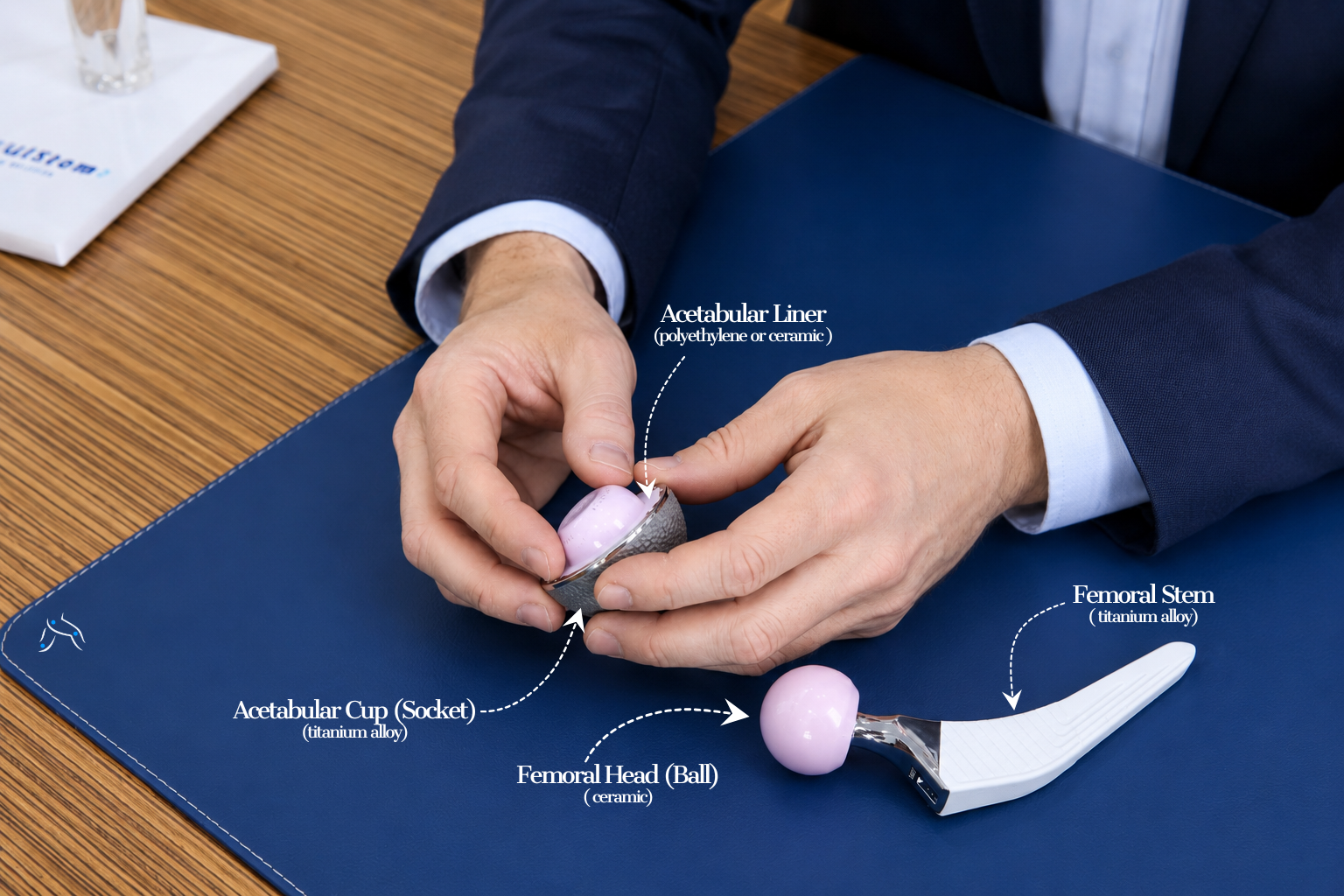
During total hip replacement surgery, the damaged surfaces of the hip joint are replaced with prosthetic components designed to recreate the natural ball-and-socket movement of the hip. The artificial hip joint typically consists of several components that work together to allow smooth and stable joint movement.
These components include:
Acetabular Cup (Socket): A metal cup is placed within the hip socket of the pelvis. This component replaces the damaged cartilage surface of the socket.
Liner: A liner is inserted inside the metal cup. This may be made from materials such as highly durable polyethylene or ceramic and allows the joint to move smoothly.
Femoral Stem: A metal stem is placed inside the thigh bone (femur). This component provides support for the artificial joint.
Femoral Head (Ball): A smooth ball component is attached to the top of the femoral stem and fits within the socket liner to recreate the natural ball-and-socket movement of the hip.
Hip replacement implants are designed using materials chosen for their strength, durability, and ability to function within the body over many years. During surgical planning, Dr Paul Harvie carefully selects the implant type and size based on your individual hip anatomy, bone quality, and the overall surgical plan.
Advantages of Total Hip Replacement Surgery

For many patients with advanced hip arthritis or joint damage, total hip replacement surgery may help improve comfort, mobility, and overall quality of life when non-surgical treatments are no longer providing sufficient relief. One of the most significant benefits of hip replacement surgery is the reduction of persistent hip pain caused by damaged joint surfaces. By replacing the worn joint with prosthetic components, the procedure aims to restore smoother movement within the hip joint.
Many patients also experience improvements in mobility and everyday function following surgery. Activities that may have previously been difficult due to pain or stiffness, such as walking, climbing stairs, or standing for longer periods, may become easier as the joint recovers.
Potential advantages of total hip replacement surgery may include:
• Relief from ongoing hip pain caused by arthritis or joint damage
• Improved hip movement and range of motion
• Greater ability to walk and perform daily activities
• Improved stability of the hip joint
• Enhanced overall quality of life for many patients
Recovery and outcomes can vary between individuals and depend on factors such as overall health, rehabilitation, and the condition of the hip prior to surgery.
What are the Potential Risks of Hip Replacement Surgery?
Total hip replacement is a commonly performed orthopaedic procedure, however, as with any surgical operation, there are potential risks and complications that patients should be aware of. Most hip replacement procedures are completed successfully, but it is important to understand that complications can occasionally occur during or after surgery. The likelihood of these risks varies depending on factors such as your overall health, the condition of the hip joint, and individual medical history.
Potential risks associated with hip replacement surgery may include:
Infection: Infection can occur around the surgical incision or deeper around the hip replacement implant. Preventative measures such as antibiotics and sterile surgical techniques are used to reduce this risk.
Blood clots (Deep Vein Thrombosis): Blood clots can occasionally develop in the veins of the leg following surgery. Patients are usually given medications and encouraged to mobilise early after surgery to help reduce this risk.
Dislocation of the hip joint: In rare cases, the artificial hip joint can dislocate if the ball moves out of the socket. Careful surgical techniques and adherence to post-operative precautions help minimise this risk.
Leg length difference: Some patients may notice a difference in leg length following hip replacement surgery. Surgical planning aims to restore normal leg length and hip alignment as closely as possible.
Implant wear or loosening over time: Hip replacement implants are designed to function for many years, but over time they may wear or loosen and occasionally require further treatment or revision surgery.
Nerve or blood vessel injury: Although uncommon, nearby nerves or blood vessels may be affected during surgery which may be permanent.
Bone fracture: A fracture of the femur or surrounding bone can occasionally occur during the procedure when preparing the bone for the implant.
Blood transfusion: Although modern surgical techniques aim to minimise blood loss, some patients may require a blood transfusion following surgery.
Iliopsoas tendinitis: In some cases, irritation of the iliopsoas tendon at the front of the hip may occur following hip replacement surgery and can cause groin discomfort.
Exacerbation of underlying medical conditions: Surgery and anaesthesia may occasionally worsen existing medical conditions such as heart disease, lung disease (including COPD), or other chronic health conditions. Careful pre-operative assessment helps identify and manage these risks.
Your surgical team will take a number of steps before, during, and after surgery to reduce the risk of complications. These include careful pre-operative planning, sterile surgical technique, and close monitoring during recovery.
Your Total Hip Replacement with Dr Paul Harvie
A step-by-step guide to your hip replacement procedure
If you and Dr Paul Harvie decide that total hip replacement surgery may be the most appropriate treatment for your condition, it is helpful to understand what the process involves. This guide outlines what you can expect from your initial consultation through to surgery and recovery.
Step 1. GP Referral & Initial Consultation
Your journey begins with a referral from your GP or another medical specialist. A referral is required to book your first appointment and ensures you receive the applicable Medicare rebate for specialist consultations. During your initial consultation, Dr Harvie will take a detailed medical history, review any previous imaging, and perform a clinical assessment of your hip. He will discuss your symptoms, how your hip condition is affecting your mobility and daily activities, and the non-surgical and surgical treatment options that may be appropriate. This appointment is also an opportunity for you to ask questions and gain a clear understanding of the procedure, recovery process, and expected outcomes of hip replacement surgery.
If total hip replacement is considered the most appropriate treatment, Dr Harvie may arrange additional diagnostic imaging to assist with surgical planning. This may include a CT scan used to create a detailed three-dimensional understanding of your hip anatomy, along with updated X-rays if required. In some cases, blood tests or general health assessments may also be organised to ensure you are medically prepared for surgery. Dr Harvie will explain the procedure in detail, including the potential benefits, risks, and recovery process. When you feel fully informed and comfortable with the treatment plan, you will be asked to complete the surgical consent process. You will also receive guidance on preparing for surgery, including practical advice about preparing your home, arranging assistance if needed, and planning for your recovery following the procedure.
Step 2. Pre-Operative Surgical Planning Analysis
Once your CT scan has been completed, Dr Harvie will use this imaging data to develop a personalised surgical plan using advanced digital planning software. This technology allows him to visualise your hip joint in three dimensions, providing a detailed understanding of your bone structure, joint orientation, and surrounding anatomy. Using this 3D model, Dr Harvie can carefully plan important aspects of your surgery before the procedure takes place.
This includes evaluating:
• The size and positioning of the implant components
• The alignment of the hip joint
• Leg length restoration
• Joint stability and muscle balance
Planning these details in advance helps guide surgical decision-making during the procedure and allows the operation to be tailored to your individual hip anatomy. This personalised planning process supports careful implant positioning and helps minimise the need for adjustments during surgery.
Step 3. Surgical Preparation and Pre-operative Steps
In the weeks leading up to your surgery, a number of steps are taken to ensure you are well prepared for your hip replacement procedure and that your overall health is optimised for surgery. You will receive detailed instructions from Dr Harvie’s team regarding pre-operative preparation, including guidance on medications, fasting requirements, and the timing of your hospital admission.
As part of your preparation, you may also attend a pre-admission assessment at the hospital. During this appointment, nursing staff and other members of the care team will review your medical history, current medications, and general health. This assessment helps ensure everything is in place for your surgery. Dr Harvie works closely with a multidisciplinary team to support patients throughout their surgical journey. This includes an anaesthetist with a particular interest in perioperative pain management, as well as a consultant perioperative physician who assists in monitoring patients during their hospital stay. You may also be provided with guidance on pre-operative exercises and physiotherapy, which can help prepare your muscles and improve mobility before surgery. In some cases, patients attend a pre-operative education program to better understand the procedure, hospital stay, and recovery process.
Before your procedure, you will also receive practical advice about preparing your home for recovery, arranging assistance if needed, and planning transportation following your hospital discharge. These steps help ensure you feel prepared and supported as you approach your surgery.
Step 4. Anaesthesia Consultation
Prior to your surgery, you will have a consultation with the anaesthetist who will be responsible for your care during the procedure. This appointment is an important part of preparing for hip replacement surgery and helps ensure that your anaesthetic plan is tailored to your individual health needs.
In many cases, this consultation is conducted over the phone, although sometimes it may take place in person depending on your medical history or specific circumstances. The anaesthetist will review your medical history, current medications, allergies, and any previous experiences with anaesthesia. They will also assess factors such as heart and lung health to ensure you are safely prepared for surgery. The anaesthetist will explain the type of anaesthesia that may be used during your hip replacement procedure. In many cases, this involves a spinal anaesthetic combined with sedation, although the exact approach will depend on your health and individual circumstances. Pain management following surgery will also be discussed.
Dr Harvie works closely with an anaesthetist who has a particular interest in perioperative pain management, helping to ensure that appropriate pain control strategies are in place both during and after your procedure.
Step 5. On the Day of Surgery
On the day of your surgery, you will arrive at the hospital at the time advised by the admissions team. After checking in, nursing staff will guide you through the admission process and help prepare you for your procedure. You will meet with members of the surgical team, including the anaesthetist, who will review the anaesthetic plan and answer any final questions you may have. Dr Harvie will also see you prior to surgery to confirm the procedure and ensure everything is in place.
The surgical site will be carefully marked, and your hip area will be prepared in the anaesthetic bay. Routine safety checks will be performed, including identity verification, confirmation of your consent, and review of any allergies or medications. Once these preparations are complete, you will be taken into the operating theatre, where your procedure will be performed in a carefully controlled sterile environment.
Step 6. The Total Hip Replacement Surgical Procedure
Once the anaesthetic has taken effect, Dr Harvie begins the hip replacement procedure using the surgical plan developed during your pre-operative planning:
Surgical incision
Dr Harvie makes an incision at the front of the hip to access the joint. In selected patients, a bikini-line incision may be used, where the incision is placed within the natural crease of the groin. The length of the incision varies depending on your body shape and the surgical exposure required but is kept as small as safely possible to allow accurate placement of the hip replacement components.
Accessing the hip joint
Through the incision, Dr Harvie works between natural muscle planes rather than cutting through major muscles. The surrounding muscles and soft tissues are gently moved aside to expose the hip joint in a controlled and precise way.
Removing the damaged joint surfaces
The worn surfaces of the hip joint are then removed. This involves removing the arthritic femoral head (the ball of the joint) and preparing the hip socket (acetabulum) by removing damaged cartilage. This step creates the foundation for placing the prosthetic components that will form the new joint.
Preparing the hip socket
The socket of the pelvis is carefully shaped to allow the new acetabular component to fit securely. Temporary trial components may be used to check alignment and positioning before the final implant is inserted.
Inserting the acetabular component
Once the correct position has been confirmed, the final acetabular cup is placed into the prepared socket. A liner is then inserted inside the cup, creating a smooth surface that allows the artificial joint to move freely.
Preparing the femur
The femur (thigh bone) is then prepared to receive the stem component of the hip replacement. Specialised instruments are used to shape the canal within the bone so the implant can sit securely.
Trial implant placement
Trial components are placed temporarily to assess leg length, joint stability, and overall alignment. This step allows adjustments to be made before the final implants are inserted.
Inserting the final components
Once the correct positioning has been confirmed, the final femoral stem is placed into the thigh bone. A metal or ceramic femoral head is then attached to the stem and positioned within the socket liner, recreating the natural ball-and-socket movement of the hip joint.
Final checks and closure
Before completing the surgery, Dr Harvie performs detailed checks to ensure the hip joint moves smoothly, the implants are stable, and leg length and alignment are balanced. The tissues are then returned to their natural position, and the incision is closed using dissolvable sutures. Local anaesthetic is applied to the area to assist with early pain control following surgery.
The procedure generally takes approximately 1 to 2 hours, although this can vary depending on individual circumstances. Most patients remain in hospital for around 2 to 4 days, with the exact duration depending on recovery progress and overall health.
How Pain Is Managed After Hip Replacement Surgery
Effective pain management is an important part of recovery following total hip replacement surgery. A number of strategies are used to help keep you comfortable after the procedure and support early movement and rehabilitation. Dr Paul Harvie works closely with the anaesthetic and perioperative care team to develop a multimodal pain management plan, which means several different methods are used together to control pain while minimising the need for stronger medications where possible.
Anaesthesia and Early Pain Control
Hip replacement surgery may be performed using either a spinal anaesthetic with sedation or a general anaesthetic combined with a nerve block, depending on your health, the type of procedure, and the recommendation of the anaesthetic team.
A spinal anaesthetic numbs the lower part of the body during surgery and is commonly combined with sedation so that you remain comfortable and relaxed throughout the procedure. This type of anaesthetic can continue to provide pain relief for several hours after surgery.
In some cases, a general anaesthetic with a regional nerve block may be used. The nerve block helps reduce pain signals from the surgical area and can assist with pain control in the early recovery period.
These approaches are designed to keep you comfortable during surgery and support effective pain control after the procedure so that early movement and rehabilitation can begin safely.
Local Infiltration Analgesia (LIA)
During surgery, Dr Harvie also uses a technique called Local Infiltration Analgesia (LIA) to help manage pain after the operation.
Local Infiltration Analgesia involves carefully injecting a mixture of long-acting local anaesthetic medications into the tissues around the hip joint during the procedure. These medications help numb the surgical area and provide targeted pain relief in the hours following surgery. By delivering pain relief directly to the tissues involved in the operation, LIA can help:
• Reduce pain immediately after surgery
• Support early mobilisation and physiotherapy
• Reduce the need for higher doses of opioid pain medications
Post-operative Pain Management
After surgery, your pain will continue to be monitored by the hospital care team. Pain relief may include a combination of medications such as:
• Anti-inflammatory medications
• Paracetamol-based pain relief
• Other medications if required for additional comfort
Dr Harvie’s patients are also supported by a perioperative physician and physiotherapy team, who assist with recovery during the hospital stay and help ensure that pain is well managed while you begin gentle movement and rehabilitation. Pain levels typically improve as healing progresses, and most patients find that discomfort gradually decreases during the early weeks of recovery.
Recovering from Total Hip Replacement Surgery
Recovery following total hip replacement surgery occurs gradually over the weeks and months after your procedure. While each patient’s recovery is different, most people begin to notice improvements in pain and mobility as the hip heals and strength returns. Shortly after surgery, you will be encouraged to begin gentle movement and walking with the assistance of physiotherapists. Early mobilisation is an important part of recovery, helping to improve circulation, reduce stiffness, and support the function of the new hip joint.
Hospital Recovery
Most patients remain in hospital for approximately two to four days following hip replacement surgery. During this time, the hospital care team will monitor your recovery, manage pain levels, and assist you in beginning physiotherapy exercises. You will usually begin standing and walking within the first day after surgery, initially with the support of a walking aid such as a frame or crutches. Physiotherapists will guide you through exercises designed to restore movement, strengthen the muscles around the hip, and help you move safely.
Returning Home
Once you are medically stable and able to move safely with assistance, you will be discharged home. Before leaving the hospital, you will receive instructions regarding:
• Caring for your surgical wound
• Medications and pain management
• Exercises and physiotherapy
• Safe ways to move and perform everyday activities
• Follow-up appointments with Dr Harvie
You will usually be provided with a short supply of medications to take home, which may include pain relief medication and, in some cases, medications to help reduce the risk of blood clots. It is important to take these medications as directed. If you require additional prescriptions once you have returned home, these will usually need to be arranged through your GP. The hospital and Dr Harvie’s rooms are generally not able to provide ongoing prescriptions after your discharge, so it is advisable to contact your GP if you are running low on medication or require further pain relief. It is also helpful to have support at home during the early stages of recovery, particularly with daily tasks such as cooking, household activities, and transportation.
Ongoing Recovery
In the weeks following surgery, mobility and strength continue to improve as you progress with physiotherapy and rehabilitation exercises. Many patients gradually return to everyday activities such as walking longer distances, driving, and light household tasks. Recovery timelines vary depending on the individual, overall health, and the level of activity before surgery. Dr Harvie will review your progress during follow-up appointments and guide you through the next stages of recovery.
Physiotherapy and Rehabilitation Guidelines After Hip Replacement
Physiotherapy and rehabilitation play an important role in recovery following total hip replacement surgery. A structured rehabilitation program helps restore movement, strength, and confidence in using your new hip joint. Physiotherapy typically begins shortly after surgery while you are still in hospital. A physiotherapist will guide you through gentle exercises designed to improve circulation, reduce stiffness, and help you begin moving safely.
Early Physiotherapy in Hospital
During your hospital stay, the physiotherapy team will assist you with:
• Standing and walking safely using a walking frame or crutches
• Gentle exercises to activate the muscles around the hip
• Learning safe techniques for getting in and out of bed, chairs, and the bathroom
• Practising stairs if required before discharge
Early movement is encouraged as it helps promote circulation, reduce stiffness, and support the healing process.
Rehabilitation at Home
After you return home, you will continue with a structured physiotherapy program to gradually rebuild strength and mobility. This may include exercises to improve:
• Hip range of movement
• Muscle strength around the hip and thigh
• Walking pattern and balance
• Overall mobility and confidence with daily activities
Many patients attend outpatient physiotherapy sessions, while others may initially perform exercises at home before progressing to supervised rehabilitation.
Gradual Return to Activity
As your recovery progresses, physiotherapy helps guide your gradual return to normal activities. Walking distances typically increase over time, and exercises are progressed to strengthen the muscles supporting the hip joint. The pace of rehabilitation varies between individuals and depends on factors such as overall health, muscle strength, and activity levels prior to surgery.
How Long Does a Hip Replacement Last?
Modern hip replacement implants are designed to be durable and long-lasting, and many patients experience many years of reliable function following surgery. Advances in implant materials, surgical techniques, and pre-operative planning have contributed to improved longevity of hip replacements. For many patients, a hip replacement may last 15 to 20 years or longer, although the lifespan of the implant can vary depending on several factors.
The long-term performance of a hip replacement can be influenced by factors such as:
• Age at the time of surgery
• Activity levels following the procedure
• Body weight and overall health
• Bone quality and joint alignment
• The type of implant components used
Higher-impact activities and excessive loading of the joint over time may increase the likelihood of implant wear.
Advances in Hip Replacement Implants
Modern hip replacement components are made from materials designed to reduce wear and improve durability. These may include combinations of highly cross-linked polyethylene, ceramic, and metal components, which allow the joint to move smoothly while minimising friction. With contemporary implants and careful surgical planning, many patients are able to maintain good hip function for many years following surgery.
When Revision Surgery May Be Required
Although hip replacements are designed to last a long time, implants may occasionally wear, loosen, or develop other issues over time. If this occurs, further treatment or revision hip replacement surgery may be considered. Dr Paul Harvie will continue to monitor your hip replacement during follow-up appointments and can assess the joint if any symptoms or concerns arise in the future.
Frequently Asked Questions About Total Hip Replacement Surgery
1. How long does total hip replacement surgery take?
Total hip replacement surgery typically takes around one to two hours, although the exact duration can vary depending on the complexity of the procedure and your individual anatomy. Additional time is required before and after surgery for anaesthesia preparation and recovery monitoring.
2. How long will I stay in hospital after hip replacement?
Most patients remain in hospital for approximately two to four days following hip replacement surgery. During this time, the medical team will monitor your recovery, manage pain levels, and assist you in beginning physiotherapy and walking safely.
3. How painful is hip replacement surgery?
Pain levels vary between individuals, but modern pain management strategies are designed to keep you comfortable following surgery. These may include spinal anaesthesia, local infiltration analgesia during the procedure, and a combination of medications after surgery to help control discomfort. Most patients notice that arthritic hip pain improves significantly once the joint has been replaced, although some post-surgical soreness is expected during the early stages of recovery.
4. When can I walk after hip replacement surgery?
Many patients are encouraged to begin standing and walking within the first day after surgery with the assistance of a physiotherapist. Walking aids such as a frame or crutches are usually used initially to provide support while your hip heals.
5. How long will I need to use crutches or a walking aid after hip replacement?
Most patients use a walking frame or crutches for the first one to two weeks after hip replacement surgery while the hip begins to recover. As strength and balance improve, patients usually transition to a single crutch or walking stick before eventually walking independently.
The exact timeframe varies depending on factors such as muscle strength, balance, and overall recovery progress. Your physiotherapist will guide you through this transition and advise when it is safe to reduce the use of walking aids.
6. How long does it take to recover from hip replacement surgery?
Initial recovery usually occurs over the first six to twelve weeks, as mobility and strength gradually improve. Full recovery and continued strengthening of the hip can, however, take several months. Your recovery timeline will depend on factors such as your overall health, activity level before surgery, and progress with physiotherapy.
7. When can I drive after hip replacement surgery?
Driving is usually possible once you are comfortable walking, able to move your leg safely, and no longer taking strong pain medications that may impair driving. This typically occurs several weeks after surgery, but the timing can vary between individuals. Dr Harvie will provide guidance during your follow-up appointments regarding when it may be safe for you to resume driving.
8. When can I return to work after hip replacement?
The timing for returning to work after hip replacement surgery depends on the type of work you do and how your recovery progresses.
Patients with sedentary or desk-based roles may return to work within 4 to 6 weeks, while those with physically demanding jobs may require a longer recovery period before returning to full duties.
Dr Harvie will review your progress during follow-up appointments and provide guidance on when it may be appropriate to resume work activities.
9. What activities should I avoid after hip replacement?
After hip replacement surgery, patients are encouraged to gradually return to everyday activities and maintain an active lifestyle. However, some high-impact activities may place excessive stress on the hip replacement over time.
Activities that may be discouraged include:
• Running or repetitive high-impact sports
• Contact sports
• Activities that involve sudden twisting or high joint loading
Lower-impact activities such as walking, cycling, swimming, and golf are often well tolerated following recovery.
Dr Harvie will provide personalised advice regarding safe activity levels and long-term joint care following hip replacement surgery.
10. When can I return to normal activities?
Many patients gradually return to everyday activities such as walking, light household tasks, and driving within the first few weeks to months following surgery. Higher levels of activity may take longer as strength and mobility continue to improve. Your rehabilitation program and physiotherapy exercises will help guide a safe and gradual return to activity.
11. When can I fly after hip replacement surgery?
Air travel may be possible several weeks after hip replacement surgery once your recovery is progressing well. The exact timing depends on factors such as your mobility, overall health, and the risk of developing blood clots during travel.
For longer flights, patients are usually advised to wait longer before travelling and may be encouraged to perform leg exercises, walk regularly during the flight, and stay well hydrated.
Dr Harvie will provide personalised advice regarding travel plans during your follow-up appointments.
12. How long does a hip replacement last?
Modern hip replacement implants are designed to be durable and long-lasting. Many hip replacements function well for 15 to 20 years or longer, although the lifespan of an implant can vary depending on factors such as activity levels, overall health, and implant wear over time.
13. Will my leg lengths be the same after hip replacement?
Restoring leg length is an important part of hip replacement surgery. During the procedure, careful planning and intra-operative assessment are used to help achieve appropriate leg length and joint stability.
Small differences in leg length can occasionally occur after surgery due to the underlying hip condition or the need to maintain joint stability. If a minor difference is present, it often improves as muscles recover and the body adapts following surgery.
Dr Harvie uses detailed pre-operative planning and surgical assessment during the procedure to support accurate implant positioning and balanced leg length.
14.Will my scar be noticeable?
The appearance of the surgical scar depends on the surgical approach used and your individual healing process. In some cases, the incision may be placed along the natural crease of the groin (bikini-line incision), which may make the scar less noticeable over time.
15. Will airport security scanners detect my hip replacement?
Hip replacement implants are typically made from metal alloys and may occasionally trigger airport security scanners. If this occurs, security staff may perform a routine manual check.
Most patients are able to travel normally after hip replacement surgery and do not require any special documentation. If you are planning travel following surgery, Dr Harvie can provide guidance on appropriate timing and precautions during your recovery.
16. How much does a hip replacement cost?
The cost of hip replacement surgery can vary depending on several factors, including the hospital, anaesthesia fees, prosthetic implants, and whether the procedure is performed in the public or private healthcare system. If you have private health insurance with appropriate hospital cover, many of the hospital costs may be covered by your insurer. There may still be out-of-pocket costs depending on your policy and the providers involved in your care.
Patients without private health insurance may still be able to access hip replacement surgery through the public hospital system, although waiting times may vary. Another option is self-funded (self-pay) surgery, where patients choose to pay privately for the procedure without using private health insurance. This may allow access to treatment in the private healthcare system without waiting for public hospital surgery. Dr Harvie’s team can provide further information regarding expected fees, self-funded options, and what may be covered by Medicare or your private health insurer.
17.Who is the best hip replacement surgeon in Hobart?
Choosing a surgeon for hip replacement surgery is an important decision. Patients may wish to consider factors such as:
• The surgeon’s training and qualifications
• Experience in hip replacement procedures
• Surgical techniques and treatment approaches offered
• The hospital where the procedure is performed
• Communication and the ability to discuss treatment options clearly
During your consultation, Dr Paul Harvie will discuss your symptoms, review imaging, and explain the treatment options available so you can make an informed decision about your care.
GET IN TOUCH